Update: Fully Licensed and Ready to Roll

February 2, 2024

My ordained ministry at Wycliffe begins: today (on Candlemas) I was licensed to the Diocese of Oxford

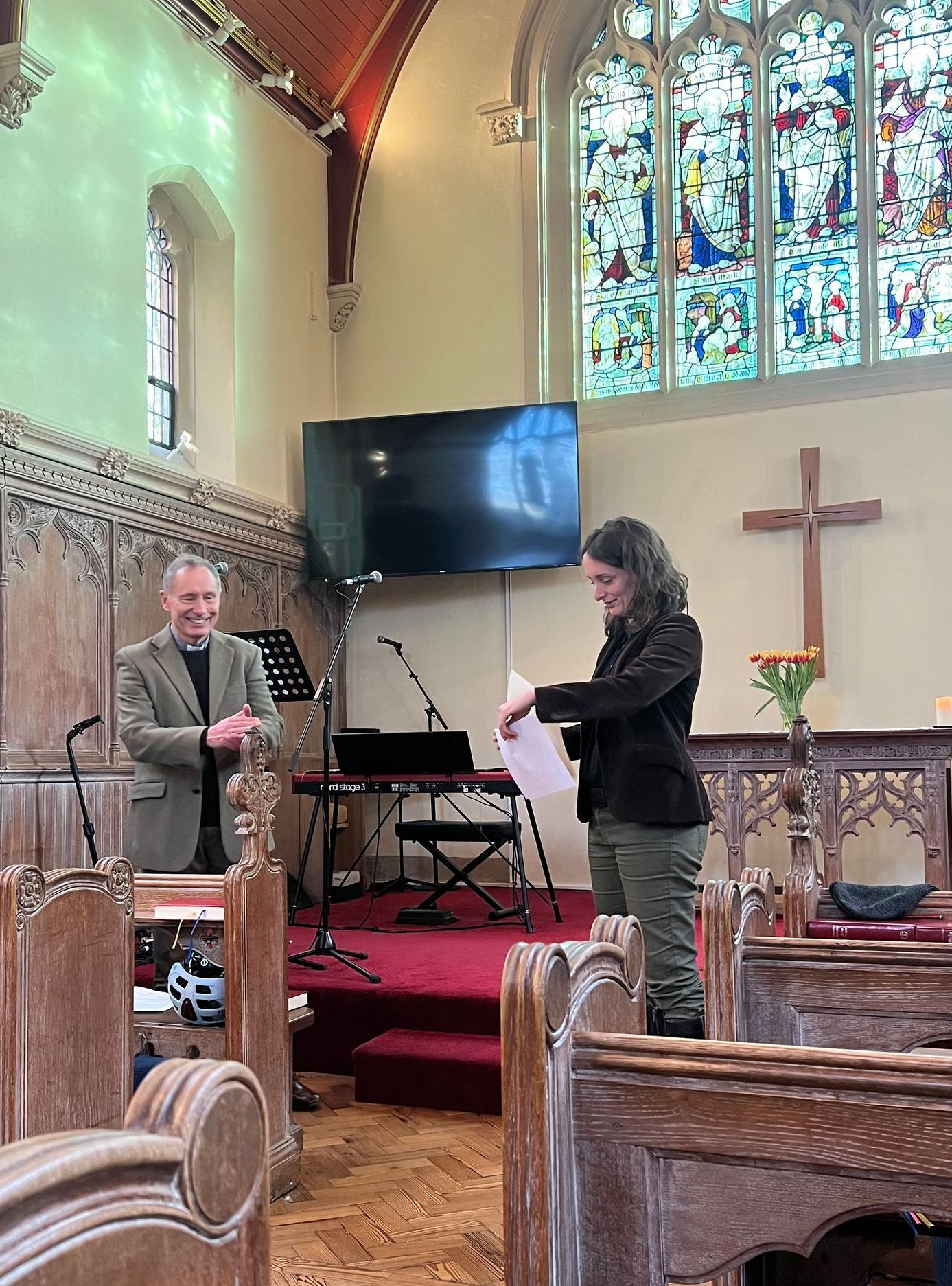
Today I was licensed to officiate as a priest at Wycliffe Hall by Archdeacon Jonathan Chaffey, on behalf of +Steven Croft (Oxford). It was a short and sweet service, with some students and staff there for moral support. I held a Bible and swore allegiance (to the Crown and to the Bishop). We read from Romans 12:1-5, the reading for today on Candlemas. And Michael Lloyd (Wycliffe Hall Principal) prayed for me. Then we had coffee and cake together the dining hall. It was lovely.


I would have thought it would be straightforward for me to minister here. However, it turns out, I am a bit of a clerical unicorn! Trained in the Church of England, ordained in the Episcopal Church but on behalf of an Anglican Bishop (and using Anglican liturgy), but despite all that I need to OPTO (Overseas Permisison To Officiate) before I can get licensed. This involved a request to the Archbishop of Canterbury and a lot of work from the Diocesan office. Thankfully, they were willing to put in the hours to make it happen--for which I am rather grateful!

I didn't realise until Chapel this morning, that today is Candlemas - the day in the church calendar that remembers the presentation of Jesus in the Temple (cf. Luke 2:22-32). In Chapel we reflected on that event and the offering made (a pair of turtle-doves) as required in the Law. In tandem we read Romans 12:1-5, both in Chapel and in my Licensing:


"I appeal to you therefore, brothers and sisters, by the mercies of God, to present your bodies as a living sacrifice, holy and acceptable to God, which is your spiritual worship. Do not be conformed to this world, but be transformed by the renewing of your minds, so that you may discern what is the will of God—what is good and acceptable and perfect.


For by the grace given to me I say to everyone among you not to think of yourself more highly than you ought to think, but to think with sober judgement, each according to the measure of faith that God has assigned. For as in one body we have many members, and not all the members have the same function, so we, who are many, are one body in Christ, and individually we are members one of another."


What a sobering reminder of the call on all of us as Christians as we live our lives and follow God's call to obedience, regardless of whether we're lay or ordained. We all have roles to play. We all have ways in which we are called to offer ourselves to God, like Christ was offered in the Temple. This is our spiritual worship. And it is not an offering of atonement, a sacrifice for sin. That has been taken care of. Nor is it a sacrifice in which we ourselves do ourselves damage. It is not self-destructive. This is a living sacrifice. A willingness to die to our own selves, our own egos and ambitions and to be raised to new life to serve God and others faithfully, wherever we find ourselves. 
It was a good reminder for me today. What I've been given, what I'm called to do (and what I'm now humanly licensed to do!) is from what I've been given as a gift of grace. And a gift from which I offer loving service and humble obedience, knowing I'm a work in progress, among works in progress.


If you feel inclined, I invite you to join me in praying this prayer for Candlemas:


Almighty and ever-living God,
clothed in majesty,
whose beloved Son was this day presented in the Temple,
in substance of our flesh:
grant that we may be presented to you
with pure and clean hearts,
by your Son Jesus Christ our Lord,
who is alive and reigns with you,
in the unity of the Holy Spirit,
one God, now and for ever.

Amen.


******

By Suse McBay March 17, 2026
Are you 100% sure about that? Last December, Stephen and I headed for Prague for a few days. We were looking forward to Christmas markets, mulled wine, and shopping. Because we had booked a really early flight, we decided to stay in an airport hotel the night before. We hadn’t banked on one thing though: how to get from the bus station at Heathrow to the hotel. We could see our destination towering ahead of us as we exited the coach, but there was no reliable way to get there on foot. Much like Houston, navigating the surface roads of Heathrow is much easier for those in a car. So, we asked for directions from one of the airport staff. She pointed us over to two elevators, sat right next to each other. One had a line of at least twenty people. The other one had none. Those at the front of the queue hadn’t even pressed the button. That seemed strange and indicated that perhaps the people in line didn’t know what they were doing—or weren’t used to London airports. But why was one line so long and the other non-existent? The signs above weren’t exactly clear, but here were two lifts side-by-side, surely they went to the same place? Towards the back of the line was a middle-aged man, surrounded by luggage and family, who realised what we were trying to puzzle out. “Nah, you can’t use it. The other lift doesn’t go down. Doesn’t go to the same place,” he told us. We looked at him quizzically. “Are you sure?” we asked. “ One hundred percent , mate. One hundred percent.” The certainty with which he declared his answer was persuasive. He crowed like he was the CEO of the airport. That lift would not go where the other one was going. He repeated himself again. 100%. Only, he was wrong. We risked looking like fools. We walked to the vacant elevator, hit the button, and—lo and behold!—an elevator appeared that went to the exact same location as the other. The middle-aged man surrounded by luggage was 100%... in the wrong. Utterly and completely. *** Words, words, words, but no wisdom I don’t personally know the man who so-confidently revealed his wrongness. I’ve no idea whether his bluster was out of character from his usual self. But in the moment of our encounter, he acted every bit the ‘fool’ we find in Book of Proverbs: "A fool takes no pleasure in understanding, but only in expressing personal opinion." (Proverbs 18:2) There is much wisdom in Proverbs 17:28: Even fools who keep silent are considered wise; when they close their lips, they are deemed intelligent. It seems to me that we live in a world saturated with words, whether written or spoken. There’s an ever-growing number of websites, social media platforms, podcasts, and so on. Even more so now with AI. Yet for all this verbal abundance, there does not seem to be any more wisdom than there used to be. I would argue with AI, there seems to be less (or perhaps it’s simply exposing our foolishness). Part of me wonders about the virtue of writing a blog, when these are so often half-thoughts, explorations, and ideas: am I just adding to the plethora of opinions that exist on the blogosphere? Last year, I was teaching on how to plan and lead funerals with our final year ordinands. I spoke with confidence about what works and what doesn’t. What the role of the cleric is, how to work with the grieving family, how to craft the sermon, what to do afterwards etc. It felt good to be able to give real, lived experience having worked in a church for a decade. But it was only during the Q&A when I realized something. I realized my confidence was borne of a very specific context: I ministered in a large, Episcopal church in Houston, Texas. Not a small parish church, somewhere remote in England. Did the wisdom and experience I bring still have value in the Church of England, where the Church is an established one? Where those who minister do among many people who don’t dare to cross the threshold of a religious building except in such moments of life and death? Now I happen to think it does; but only with some qualification. For what I realized in that moment is that it’s not quite as readily transferable as I’d assumed. Church cultures are different. Expectations are different. How people respond and react to their local vicar is different! What works in one scenario doesn’t necessarily work in another. Consider Proverbs 26:4-5: 4 Do not answer fools according to their folly, or you will be a fool yourself. 5 Answer fools according to their folly, or they will be wise in their own eyes. Proverbs 26 has a seeming contradiction that speaks to the importance of context. In the situation where you’re faced with someone spouting foolishness, what should you do? Speak or not speak? Engage or not engage? The modern equivalent to v.4 might be to say to yourself “not my monkeys, not my circus” and walk away. But what about the times when it is your circus? When they are your monkeys? What about when to walk away is to leave someone blind to their mistakes and doomed to make more? What if responding might feasibly help someone see beyond their own blinkers and make a different choice? Sometimes v.4 might be the path of wisdom. Other times it’s v.5. But it’s not always apparent which is which. Overconfidence is not just dangerous for making us look like fools or giving bad advice. If we stay in our certitude, we miss the heart of the issue revealed in these two verses: we need wisdom. So where do we find it? *** Does ‘wisdom come with age’? I’ve heard it said that ‘wisdom comes with age’. Ironically enough, this line was used when I was in something of a disagreement with someone much older than me. But claiming moral high ground or superior understanding on the basis of some unalterable characteristic that you have but I don’t, is more indicative of pride than wisdom. If age does come with wisdom, there would be no conflict or disagreement within the human species as we age. If age is the sole arbiter, we should collectively do better as the wrinkles and grey hairs multiply. Yet that’s not what happens. Wisdom, sadly, is not inevitable. It can come with age because of one very simple reality: the more time you’ve had on the planet means you’ve had more opportunity to become wise. Now whether or not you’ve taken those opportunities is quite a different thing! *** Wisdom: a gift that needs seeking Proverbs has an interestingly balanced view of wisdom. It is (1) something that requires active seeking, yet also (2) something which only God can give. Proverbs 2:1-4 talks about the need to exert effort in acquisition of wisdom. It’s not something that just lands on our laps: it asks you to be open to learning and sitting with what you receive (v.1), deliberate and intentional in putting your body in a space to grow in it (v.2), and vocal in your search for it (v.3). In other words: humble, open, and hungry. This passage concludes by likening it to searching for silver or hidden treasure (v.4). Think about that for a moment: do you search for wisdom in the same way you seek out growth in income or asset? From a human wisdom point of view, seeking financial gain for our security and future as we age (and our children grow and go off to college etc) makes good sense. But what if we were to seek wisdom with the very same fervour? What if wisdom had the same significance for our spiritual security and future? What if it is important to our growth in the Christian life and readiness for what may come our way? It’s a gift that needs seeking. But Proverbs tells us it is also a gift that is given. Verse 6 reveals “ the LORD gives wisdom; from his mouth come knowledge and understanding .” Our seeking is not the whole picture. Longing for wisdom does not mean we get it. Wisdom is God’s domain not ours. Proverbs 8 illustrates that God’s Wisdom is not something to acquire or harvest. It is not a commodity to be doled out. It is not a consumer good. Wisdom was present when God made the world. Wisdom is a part of God’s self that chooses when to be imparted and when not to be (compare 1:28; 8:17; 9:5, 16) The very fabric of our material world is infused with the mystery of Wisdom. Insight and understanding comes from God and helps us to navigate the complexity of our lives, but this gift is just a glimpse of a much greater reality of the divine Wisdom which exists eternally. This, perhaps, brings us back to where I started. True wisdom is never found in loud proclamations of “one hundred percent!”. Why? Because the one who is wise recognises they have a lot to learn. They know that new information can shift and reframe yesterday’s certainty. Maybe the first step is to stop claiming absolute certainty—to stop the all-or-nothing thinking. Maybe we start with recognising what Paul talks about in 1 Corinthians 13: we only see in part, know in part, understand in part. And from there, we begin actively seeking that gift which only God—from His Wisdom—can give. Wisdom has built her house, she has hewn her seven pillars. 2 She has slaughtered her animals, she has mixed her wine, she has also set her table. 3 She has sent out her servant-girls, she calls from the highest places in the town, 4 "You that are simple, turn in here!" To those without sense she says, 5 "Come, eat of my bread and drink of the wine I have mixed. 6 Lay aside immaturity, and live, and walk in the way of insight." Proverbs 9:1-6 ****** Photo © Copyright Derek Harper and licensed for reuse under a cc-by-sa/2.0 Creative Commons Licence.
By Suse McBay February 13, 2026
What do we do on days when God seems entirely absent? Some thoughts about where I see that in my life today and, looking back, recognising how much has changed.

Join us in Oxford in 2025!

Subscribe to

My Newsletter

Sign up here to receive quarterly updates (and occasional other news blasts) about how ministry is going and our move to the U.K.