So what's next?

May 19, 2023

So what's next for the McBays?

So what am I up to? Why a website? What's happening?


Stephen and I have been married almost ten years. We have two things that we share at the foundation of our relationship and our faith. (1) We'll go anywhere and do anything (God tells us to do), (2) the safest place to be is in God's will. Bold principles to live by but, I'd argue, also the best. That's the short answer of how we got here. Now for the longer one...


  • Almost 20 years ago, God made it very clear to me, while I was camping in the Australian outback with a group of young Christians, that He had called me to be a teacher. It was confirmed in completely unexpected ways, several times, from people I barely knew and with a caveat that it would not look as I might expect it to look…
  • A few years later, after some prayer, God made it very clear that He was calling me to ordination—something I categorically did NOT want to do and had strongly resisted the idea of for years.
  • A few years after that, while at seminary, God made it very clear to me that He was calling me to a PhD in biblical studies. I’d always loved biblical studies, but I had disqualified myself from even thinking about taking it further because I didn’t look like a traditional biblical scholar.


I have loved so much of what I have been able to do in and through my ministry at St. Martin's. It's been a huge privilege and I have been incredibly grateful to really get to do so much of what I love and to serve God's kingdom in and through the life of this particular parish. I never imagined for a minute I'd end up in Houston, Texas, at the largest Episcopal church in North America! But it has been a blessing in many different ways.


However, throughout my life and work thus far, I've always found myself somewhere in the overlap between education and the church. (Imagine a venn diagram with "church" in one circle and "theological education" in the other -- I've found myself where they crossover). I've taught high school, seminary, undergrad, overseas (the Far East) and adult Sunday School in sunny Texas. I've preached in a number of those places too. I love teaching. I love preaching. I love research. When I went forward for selection for ordination I was pegged as "potential theological educator" because of those two hats - the ministerial and the academic.

While there have been many strands of prayer and reflection that have gone into my decision to make a change, one core reason is that I really believe God has called me to serve both the church and the academy. Not only do seminaries need lecturers (aka professors) who care about Scripture and can help pastors and teachers who are well-trained and informed in biblical scholarship and interpretation, they also need a safe place to land when challenged by their academic learning. I have spent a lot of time in theological education and my faith was shaken, honed and (ultimately) refined. But this journey was encouraged along by faculty who were trained and educated with the best of them and also had a deep and Spirit-filled life of faith in Jesus. They listened to my questions. They gave me space to wrestle through the difficulties of having my naive faith confronted by biblical criticism. They helped me separate the theological wheat from the irrelevant chaff. And they helped me to still seek Jesus, even in all of that uncertainty. 
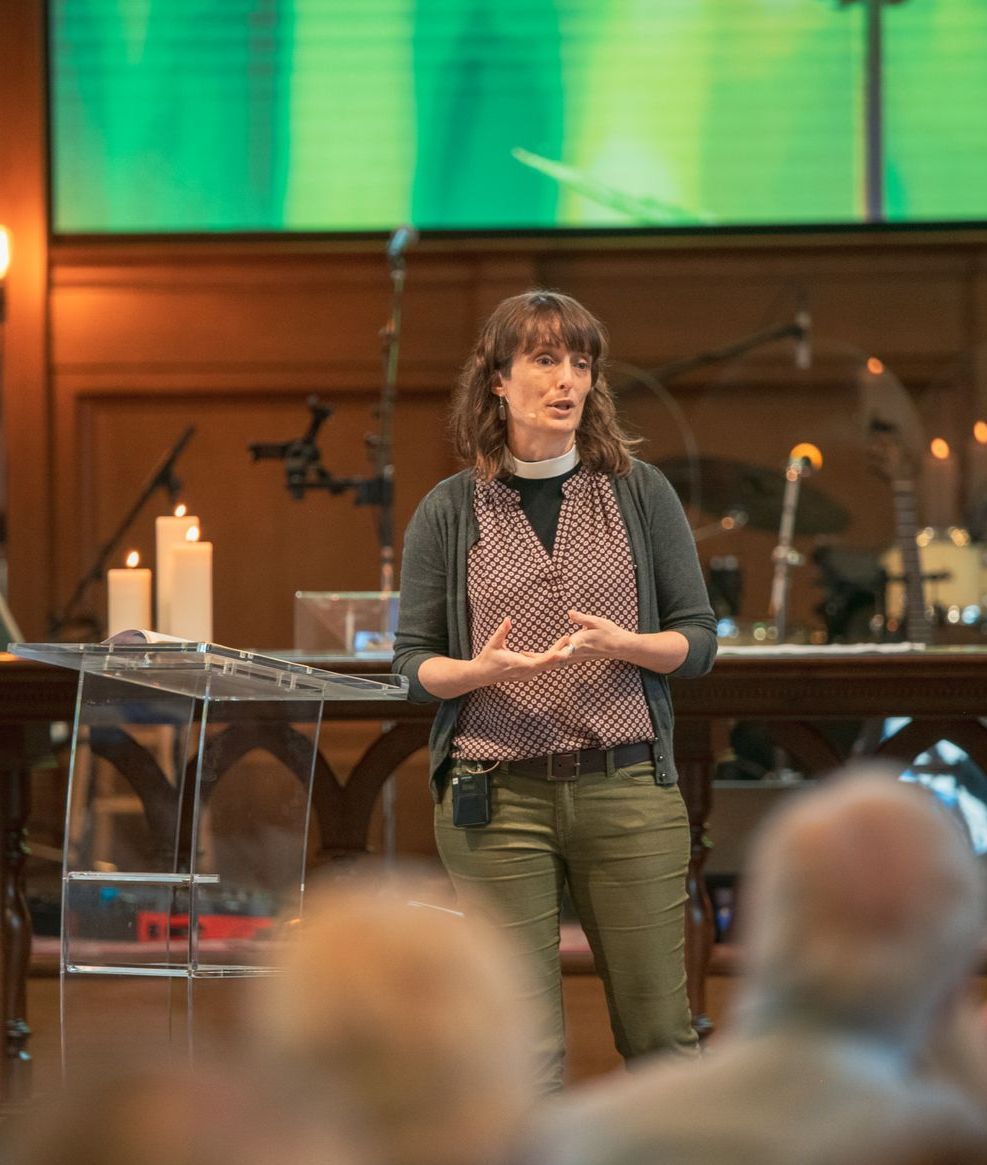
The church needs pastors who are well-trained and theologically informed -- and the academy needs tutorial staff who have a commitment to both the book-learning and the one about whom the books attempt to speak.


Serving at St. Martin's has given me a wonderful experience of ministry, from pastoral care and walking grieving families through the death of a loved one, to preaching to a nave full of people to launching Riverway as an fresh expression of our Anglican heritage. I want to take this experience, with my heart for teaching and the academy and use it best for God's service.


But in order to take a step forward, sometimes you gotta take a step back!


For various reasons, Stephen and I came to the conclusion God was calling for us to take the risk of creating space in our schedules (and a gap in my regular paycheck) to prepare for this transition. While the world says we should always be jumping from one thing to the next and never taking a breath, we're pretty sure that God calls us to live one day at a time, one moment at a time and to trust Him, even when the stakes seem high.


I am hopeful I will be able to take up an academic position by the end of the year. Wycliffe Hall is currently looking to expand their faculty with a lecturer (aka professor) who can help shape and equip clergy and other missionaries and ministers. Who can teach biblical studies, preaching, and help students apply their biblical learning to the reality of pastoral ministry. To find out more about Wycliffe Hall and help support them in this effort, click here. I believe this would be a really great fit for me and is where God is calling us next!


By Suse McBay March 17, 2026
Are you 100% sure about that? Last December, Stephen and I headed for Prague for a few days. We were looking forward to Christmas markets, mulled wine, and shopping. Because we had booked a really early flight, we decided to stay in an airport hotel the night before. We hadn’t banked on one thing though: how to get from the bus station at Heathrow to the hotel. We could see our destination towering ahead of us as we exited the coach, but there was no reliable way to get there on foot. Much like Houston, navigating the surface roads of Heathrow is much easier for those in a car. So, we asked for directions from one of the airport staff. She pointed us over to two elevators, sat right next to each other. One had a line of at least twenty people. The other one had none. Those at the front of the queue hadn’t even pressed the button. That seemed strange and indicated that perhaps the people in line didn’t know what they were doing—or weren’t used to London airports. But why was one line so long and the other non-existent? The signs above weren’t exactly clear, but here were two lifts side-by-side, surely they went to the same place? Towards the back of the line was a middle-aged man, surrounded by luggage and family, who realised what we were trying to puzzle out. “Nah, you can’t use it. The other lift doesn’t go down. Doesn’t go to the same place,” he told us. We looked at him quizzically. “Are you sure?” we asked. “ One hundred percent , mate. One hundred percent.” The certainty with which he declared his answer was persuasive. He crowed like he was the CEO of the airport. That lift would not go where the other one was going. He repeated himself again. 100%. Only, he was wrong. We risked looking like fools. We walked to the vacant elevator, hit the button, and—lo and behold!—an elevator appeared that went to the exact same location as the other. The middle-aged man surrounded by luggage was 100%... in the wrong. Utterly and completely. *** Words, words, words, but no wisdom I don’t personally know the man who so-confidently revealed his wrongness. I’ve no idea whether his bluster was out of character from his usual self. But in the moment of our encounter, he acted every bit the ‘fool’ we find in Book of Proverbs: "A fool takes no pleasure in understanding, but only in expressing personal opinion." (Proverbs 18:2) There is much wisdom in Proverbs 17:28: Even fools who keep silent are considered wise; when they close their lips, they are deemed intelligent. It seems to me that we live in a world saturated with words, whether written or spoken. There’s an ever-growing number of websites, social media platforms, podcasts, and so on. Even more so now with AI. Yet for all this verbal abundance, there does not seem to be any more wisdom than there used to be. I would argue with AI, there seems to be less (or perhaps it’s simply exposing our foolishness). Part of me wonders about the virtue of writing a blog, when these are so often half-thoughts, explorations, and ideas: am I just adding to the plethora of opinions that exist on the blogosphere? Last year, I was teaching on how to plan and lead funerals with our final year ordinands. I spoke with confidence about what works and what doesn’t. What the role of the cleric is, how to work with the grieving family, how to craft the sermon, what to do afterwards etc. It felt good to be able to give real, lived experience having worked in a church for a decade. But it was only during the Q&A when I realized something. I realized my confidence was borne of a very specific context: I ministered in a large, Episcopal church in Houston, Texas. Not a small parish church, somewhere remote in England. Did the wisdom and experience I bring still have value in the Church of England, where the Church is an established one? Where those who minister do among many people who don’t dare to cross the threshold of a religious building except in such moments of life and death? Now I happen to think it does; but only with some qualification. For what I realized in that moment is that it’s not quite as readily transferable as I’d assumed. Church cultures are different. Expectations are different. How people respond and react to their local vicar is different! What works in one scenario doesn’t necessarily work in another. Consider Proverbs 26:4-5: 4 Do not answer fools according to their folly, or you will be a fool yourself. 5 Answer fools according to their folly, or they will be wise in their own eyes. Proverbs 26 has a seeming contradiction that speaks to the importance of context. In the situation where you’re faced with someone spouting foolishness, what should you do? Speak or not speak? Engage or not engage? The modern equivalent to v.4 might be to say to yourself “not my monkeys, not my circus” and walk away. But what about the times when it is your circus? When they are your monkeys? What about when to walk away is to leave someone blind to their mistakes and doomed to make more? What if responding might feasibly help someone see beyond their own blinkers and make a different choice? Sometimes v.4 might be the path of wisdom. Other times it’s v.5. But it’s not always apparent which is which. Overconfidence is not just dangerous for making us look like fools or giving bad advice. If we stay in our certitude, we miss the heart of the issue revealed in these two verses: we need wisdom. So where do we find it? *** Does ‘wisdom come with age’? I’ve heard it said that ‘wisdom comes with age’. Ironically enough, this line was used when I was in something of a disagreement with someone much older than me. But claiming moral high ground or superior understanding on the basis of some unalterable characteristic that you have but I don’t, is more indicative of pride than wisdom. If age does come with wisdom, there would be no conflict or disagreement within the human species as we age. If age is the sole arbiter, we should collectively do better as the wrinkles and grey hairs multiply. Yet that’s not what happens. Wisdom, sadly, is not inevitable. It can come with age because of one very simple reality: the more time you’ve had on the planet means you’ve had more opportunity to become wise. Now whether or not you’ve taken those opportunities is quite a different thing! *** Wisdom: a gift that needs seeking Proverbs has an interestingly balanced view of wisdom. It is (1) something that requires active seeking, yet also (2) something which only God can give. Proverbs 2:1-4 talks about the need to exert effort in acquisition of wisdom. It’s not something that just lands on our laps: it asks you to be open to learning and sitting with what you receive (v.1), deliberate and intentional in putting your body in a space to grow in it (v.2), and vocal in your search for it (v.3). In other words: humble, open, and hungry. This passage concludes by likening it to searching for silver or hidden treasure (v.4). Think about that for a moment: do you search for wisdom in the same way you seek out growth in income or asset? From a human wisdom point of view, seeking financial gain for our security and future as we age (and our children grow and go off to college etc) makes good sense. But what if we were to seek wisdom with the very same fervour? What if wisdom had the same significance for our spiritual security and future? What if it is important to our growth in the Christian life and readiness for what may come our way? It’s a gift that needs seeking. But Proverbs tells us it is also a gift that is given. Verse 6 reveals “ the LORD gives wisdom; from his mouth come knowledge and understanding .” Our seeking is not the whole picture. Longing for wisdom does not mean we get it. Wisdom is God’s domain not ours. Proverbs 8 illustrates that God’s Wisdom is not something to acquire or harvest. It is not a commodity to be doled out. It is not a consumer good. Wisdom was present when God made the world. Wisdom is a part of God’s self that chooses when to be imparted and when not to be (compare 1:28; 8:17; 9:5, 16) The very fabric of our material world is infused with the mystery of Wisdom. Insight and understanding comes from God and helps us to navigate the complexity of our lives, but this gift is just a glimpse of a much greater reality of the divine Wisdom which exists eternally. This, perhaps, brings us back to where I started. True wisdom is never found in loud proclamations of “one hundred percent!”. Why? Because the one who is wise recognises they have a lot to learn. They know that new information can shift and reframe yesterday’s certainty. Maybe the first step is to stop claiming absolute certainty—to stop the all-or-nothing thinking. Maybe we start with recognising what Paul talks about in 1 Corinthians 13: we only see in part, know in part, understand in part. And from there, we begin actively seeking that gift which only God—from His Wisdom—can give. Wisdom has built her house, she has hewn her seven pillars. 2 She has slaughtered her animals, she has mixed her wine, she has also set her table. 3 She has sent out her servant-girls, she calls from the highest places in the town, 4 "You that are simple, turn in here!" To those without sense she says, 5 "Come, eat of my bread and drink of the wine I have mixed. 6 Lay aside immaturity, and live, and walk in the way of insight." Proverbs 9:1-6 ****** Photo © Copyright Derek Harper and licensed for reuse under a cc-by-sa/2.0 Creative Commons Licence.
By Suse McBay February 13, 2026
What do we do on days when God seems entirely absent? Some thoughts about where I see that in my life today and, looking back, recognising how much has changed.

Join us in Oxford in 2025!

Subscribe to

My Newsletter

Sign up here to receive quarterly updates (and occasional other news blasts) about how ministry is going and our move to the U.K.