New Sermon: Dealing with Frustrations (Phil 2:14-end)

October 10, 2024

A sermon given in Wycliffe Chapel during Morning Prayer in Welcome Week 2024 on Philippians 2.

I want to start this morning with a question: if the world looked at your character today, would they want to worship your God?


If an inquiring mind and open spirit who was looking for answers to life’s deepest questions got to know you, what would they see? If they saw how you react first thing in the morning after you woke up and before the first cup of tea or coffee of the day. Or when you have to wait for a family member or housemate to vacate the bathroom? How you act on the school run, deal with traffic, manage your workload or when you start to get tired or hungry?


If a curious onlooker saw your responses to life’s daily tests: would it draw them near to your God? Or would it be same old thing they always see in themselves, their neighbours and the world around them?


That is more-or-less the idea Paul is getting at here in Philippians 2. In v.14-15 he says:

"Do all things without murmuring and arguing, so that you may be blameless and innocent, children of God without blemish in the midst of a crooked and perverse generation, in which you shine like stars in the world."


***

If you want to find the foremost grumblers in the Bible, you don't need to look very long. They're there right in the second book of the Bible: the Israelites in the wilderness after being delivered from slavery in Egypt. Looking through the the biblical tradition, the Israelites didn't have a great reputation. They are primarily remembered as grumblers. Complainers. In popular culture we might hear the phrase ‘toxic positivity’ - well, the Israelites in the wilderness were the opposite. Theirs was a ‘toxic negativity.’


And toxic it was. Not only were they remembered for it, but their complaining is, in later biblical texts, associated with them as a rebellious people. Disobedient. Sinful. So much so Deuteronomy 32 condemns them as a crooked and perverse generation. Not blameless: but guilty.


Grumbling might seem superficially insignificant—for the Brits in the room it might feel like a national sport—but in truth it reveals some serious spiritual sickness.


And Paul doesn’t just say don’t complain sometimes. No, in all things: not just at work, but at home too. Not just at home, but also on the sports field. Or—and this is a bit of a confession here—when waiting for the reliably late S3 Stagecoach bus service from the Woodstock Rd to The Paddocks in Yarnton.


Do all things without complaining.


***


In my adult life I have spent a total of 7 years as a student in fulltime theological education. In the course of every one of those seven years if someone had asked me what’s the best thing about theological college, I would have said without hesitation: "The community." But, if they had also asked the opposite question, what’s the worst thing about theological college? I would have also answered: "The community."


It’s only Thursday of 0th week of Michaelmas Term. We are a new community—new students and old—finding out feet. Hopefully, most of us are still in the honeymoon phase and aren’t yet at the hard work part; but it will undoubtedly hit at some point.


So what we do when we get there? When we hit the first frustrations of the year? When the timetable seems just too full, deadlines seem far too close, we get riled by a conversation over lunch and then come to chapel to find we are worshiping in a style that we just don't like? What are we to do?


***

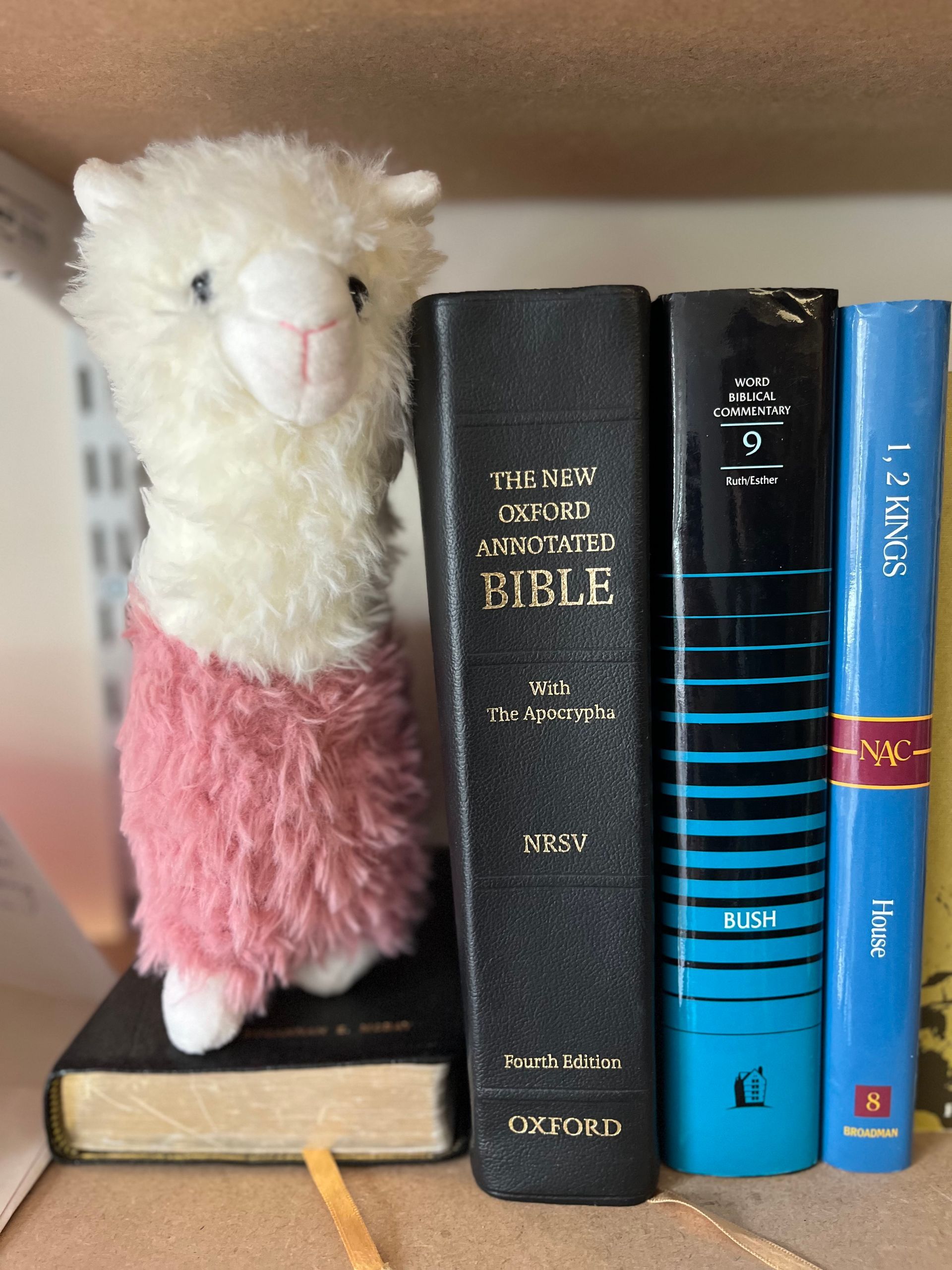
I want to introduce you to a member of the community you haven’t met yet. He's been living with Stephen and I a few months, but he's come with me today and will be taking up residence in my study.


This is my drama llama [pictured]. If you want to find him, he’ll be in my study. He came as a pair: this one is the runt of the litter. The first was a gift to a friend who deals in his day-to-day life with a lot of complaints and grumbling. The drama llama’s job, apart from making my friend smile, is to be a visual reminder that there is a difference between negative feelings as they arise and the stories people can so often start telling, again and again because of them. 

***


It’s really important to know the difference between frustration and grumbling. Frustration is lighting a match. Grumbling is throwing it on a pile of a kindling.


If we don’t know the difference, we end up responding to the irks of life in a way that makes us like any other. We nurse them. We start telling ourselves a story about what the irritation really means.


We start assessing motives and interpret what's happened. We make it personal, about us.

Frustration turns into indignation which turns into anger which turns into self-righteouesness.


But when we do know the difference, we acknowledge the frustration, but put the brakes on before it becomes griping and before we get carried away with our version of events? Then, by God’s grace, the frustration becomes our teacher.


For it invites us to turn our attention inward and ask the question: what am I afraid of here? Why am I so angry? Or upset? Why am I reacting as I am? And where do I need God’s grace in this moment? What was an opportunity for temptation to sin, to rebelliousness and disobedience, thus becomes God’s means of redeeming us, building us up in our faith and teaching us to trust Him.


Why?


So that we might become blameless and innocent, and shine brightly like stars in the sky.


******



By Suse McBay April 14, 2026
A few weeks ago, I got to sit down via the wonders of the internet and have a catch-up with my friend and former colleague, Wayne Watson. We talked God, life, and the universe. And Winnie the Pooh! In Wayne's own words " What begins as lighthearted conversation between old friends quickly unfolds into a thoughtful and wide-ranging exploration of culture and the pursuit of God's truth. " It was fun. If you fancy a listen, check out the podcast (and the entire series) by clicking here ! ******
deute
By Suse McBay April 8, 2026
***** I’ve long noticed that the Bible that gets preached from the Sunday pulpit can be, well, a bit picky. Some bits are kept in and preached. Others are studiously ignored. The result? Different churches can give quite a different sense of what the Bible's message is than if you actually read it through cover to cover. Now I don't mean to accuse any one wing of the church: whether your tradition uses the lectionary (usually a three-year cycle of curated readings) or jumps around the canon to whichever biblical book or theme is of interest, certain parts of the Scriptures are often ignored. Some passages are cut off halfway through; others are omitted entirely. I remember preaching on Independence Day in the US (the irony of doing so as a Brit was not lost on me). The reading for the day began in Deuteronomy 10:17: “For the LORD your God is God of gods and Lord of lords, the great God, mighty and awesome, who is not partial and takes no bribe, who executes justice for the orphan and the widow, and who loves the stranger, providing them food and clothing…” Sounds lovely, right? Well, yes—but Deuteronomy 10:17 starts in the middle of a paragraph. In the middle of divine instruction that God gives through Moses. We can see this in how it begins: for the LORD your God.. . It could also be translated because the LORD your God … This passage is the explanation for something. It is a why to a biblical command, not a standalone theological statement. So what’s the actual command? What’s the main message God wants the people to hear? The verse before (v.16) says this: “Circumcise, then, the foreskin of your heart, and do not be stubborn any longer.” The purpose of this speech? To call God’s people to repentance. To change. The ‘heart’ in biblical texts usually refers to one’s innermost self. The seat of who you are in the deepest places of your will and desire. God has said he wants their obedience (v.12), he has reminded them of his extraordinary generosity in choosing them as his people (vv.13–15), but here God lands a punch: The centremost part of who you are, God says, needs to be clipped. Reading vv.17–22 feels quite different in light of the whole text. It’s not a statement of a good God whom we should simply ‘fear’ and ‘hold fast to’ (v.20). It’s far more rooted and real than that. In reading through all ten verses, we get a sense of a people who have become too big for their boots. Who have forgotten that it’s not because they have anything to offer that God chose them, but rather because of the graciousness of God. And we get a clear call from God that such people need to, in essence, sort themselves out. Be humbled. Circumcise their hearts. I don’t believe the Sunday lectionary was formed with a conspiratorial agenda to omit the hard stuff (the whole thing would largely be read through in the daily lectionary for the Daily Office). But I do believe it’s spiritually dangerous for us to ignore the material that is left on the cutting room floor in our preaching. The people of God are called to grow into the fullness of the gospel—to become mature Christians. If we only ever swim in the protected waters of the lectionary, we will not be confronted by the reality of a God who regularly and reliably calls his people to humble themselves, care for those in need, and live lives of sacrificial love. Who makes space within their communities for the vulnerable. Who looks out for the marginalised among us. Who deals with the darkest and ugliest of human evil. Who redeems out of family lines and dynasties most of us would give up on. In recent years, there has been increasing focus on the importance of the gut–brain connection. How what you eat shapes who you are, and how you function mentally, emotionally, and physically. What we fuel ourselves with matters. The same is true spiritually. The Bible is the spiritual equivalent of a Whole30. Or a wholemeal, organic, seed-infused sourdough loaf. It’s nutritious and gritty. It requires some chewing. It’s not always easy to digest. But it provides the minerals and nutrients we need. It may take some adjustment, but it may also be just what the doctor ordered. Not for our physical sicknesses, but rather our more pernicious spiritual malaise. ******

Join us in Oxford in 2025!

Subscribe to

My Newsletter

Sign up here to receive quarterly updates (and occasional other news blasts) about how ministry is going and our move to the U.K.